The physics of fiber-reinforced ice, the infrared method, and the results of the October 3–4, 2026 test, including its limits.
How fiber-ice works
Plain ice and saturated gel melt from the outside in and from the warmest side first. Meltwater collects, the frozen core shrinks and shifts, and the surface ends up with cold pockets next to warm areas.
In DuraTherm, cotton fiber runs through the whole volume of water. The fiber holds the water in place by wicking, both frozen and liquid, so the cold stays spread through the pack instead of collecting in one spot. It is the same principle that let Pykrete melt slowly: wet fiber at the surface insulates the frozen interior.
What happens when cotton gets wet
Cotton fibers swell by about 10% in diameter when hydrated, porosity drops by about 11%, and permeability drops by about 60%.
The fibers straighten and push outward with real force, which helps spread the fiber into under-filled areas of the pack.
Cotton can hold more water than is added, which is why thawed packs held with an open ½–¾ inch port showed zero water extrusion over 60+ days of handling.
The ingredients
Water, cotton, and borax at 1–2% as a preservative. No sodium polyacrylate or other superabsorbent gel.
Infrared method
Each pack's rear face was photographed with a thermal camera at every read. Labels on the front face read unreliably in infrared, so only the clean rear face was measured.
Zones: the center 80% of the face, plus top (neck), bottom, left and right edge zones, and the whole face.
Calibration: each image was read from its own temperature scale and anchored to the camera's own center-spot reading.
Outlines: pack edges were traced by hand on copies of each image; the originals were never altered.
Shape mask: the gaps beside the neck and outside the rounded corners were excluded, so floor pixels never count as pack.
Statistics: each pack is one unit. Groups were compared with Mann-Whitney and Welch t-tests.
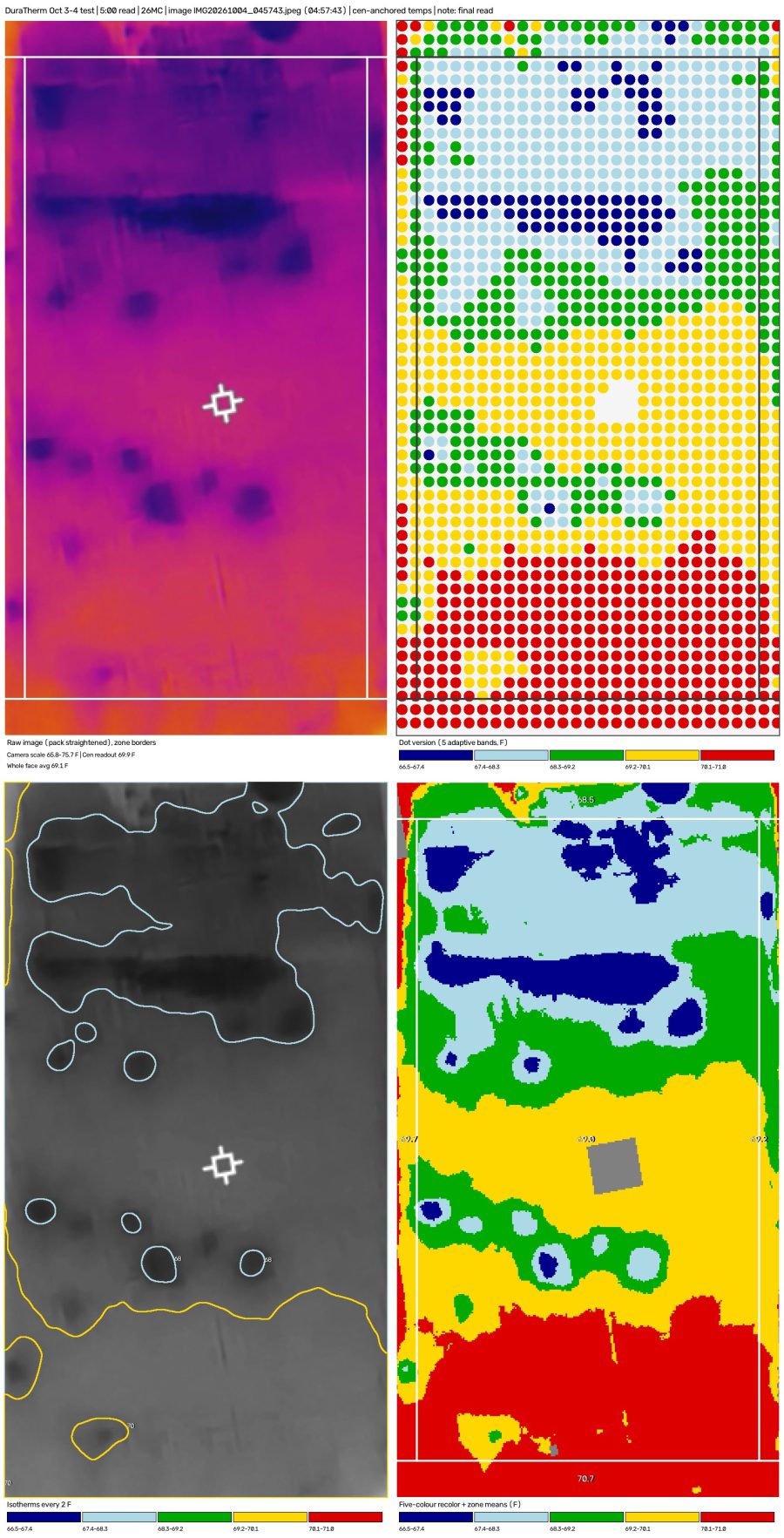
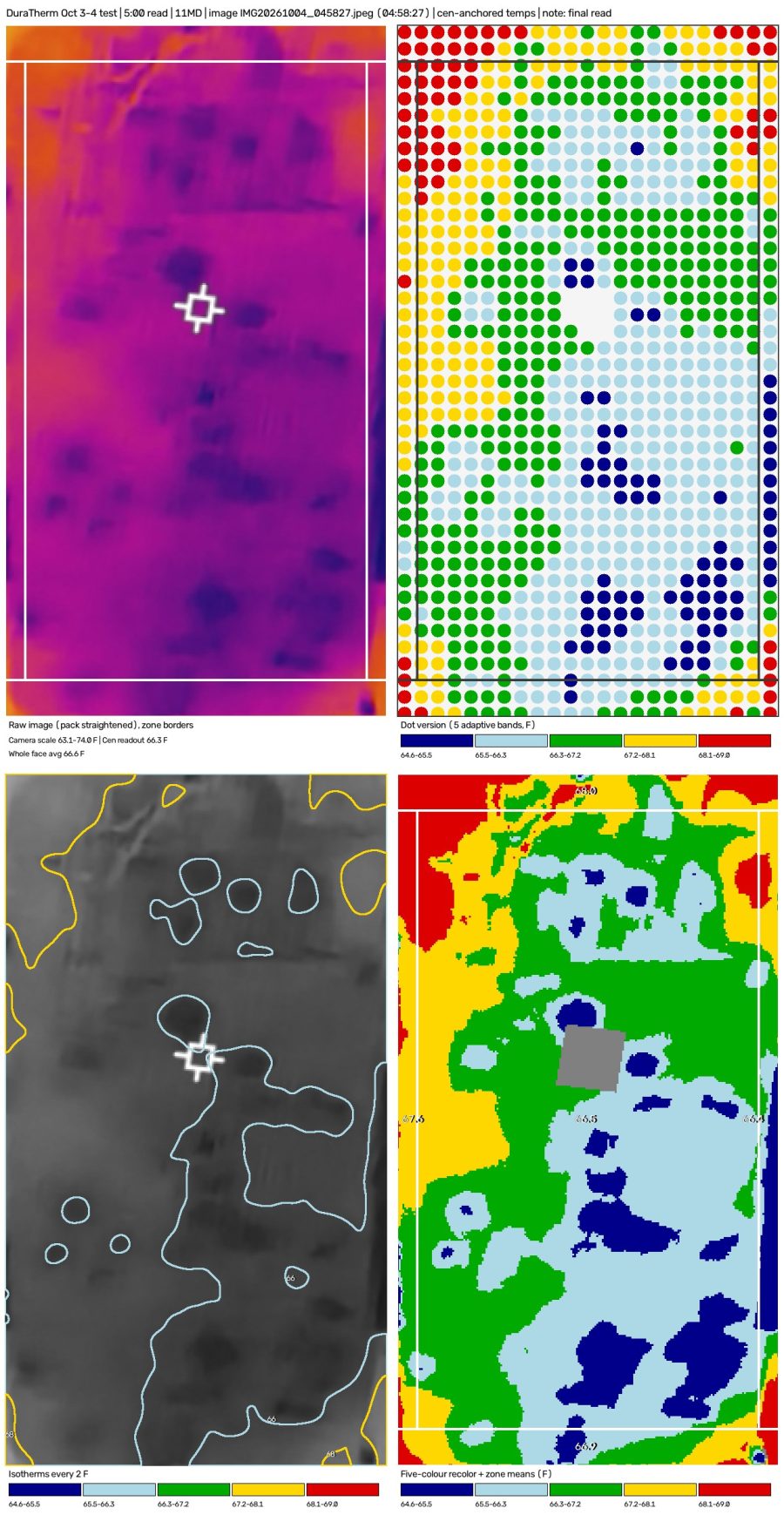
Analysis panels at 5:00 a.m. for gel pack 26MC (left) and DuraTherm pack 11MD (right): straightened raw image with zone borders, dot map, 2°F isotherms, and a five-color map with zone averages.
Results
0 of 23DuraTherm packs ever reached the 70°F out-of-range line
10 of 27standard gel packs were at or above 70°F at the 5:00 a.m. read
½ the rateDuraTherm warmed 0.86°F per hour vs 1.68°F for gel packs (3:00–5:00 a.m.)
2.8°F colderaverage surface at 5:00 a.m.: 66.7°F vs 69.4°F
Standard gel pack (27)DuraTherm (23)
Average whole-face surface temperature of the 27 gel packs and 23 DuraTherm packs at each overnight read. The dashed line is the 70°F out-of-range line. Hover a point for its value.
Standard gel pack (27)DuraTherm (23)
Within-pack spread: the standard deviation of temperature across each pack face, averaged per group. Lower means a more even pack.
Standard gel pack (27)DuraTherm (23)
Pack-to-pack spread: the standard deviation of the whole-face averages within each group. Lower means the packs of that type behave more alike.
Read (Oct 4)
Gel pack avg
DuraTherm avg
Gel pack spread
DuraTherm spread
Gel packs ≥ 70°F
DuraTherm ≥ 70°F
1:30 a.m.
62.8°F
60.3°F
2.37
1.76
0
0
2:00 a.m.
62.5°F
63.0°F
2.02
1.61
0
0
2:30 a.m.
65.6°F
63.8°F
1.55
1.20
6
0
3:00 a.m.
65.7°F
64.3°F
1.42
1.09
5
0
3:30 a.m.
67.9°F
66.9°F
1.18
1.36
7
0
4:30 a.m.
68.8°F
66.5°F
1.11
0.84
8
0
5:00 a.m.
69.4°F
66.7°F
1.19
0.84
10
0
Spread = average within-pack standard deviation (°F). Packs were flipped before the 2:00 and 3:00 a.m. reads, which briefly evens out a freshly exposed face. There was no 4:00 a.m. read.
Uniformity. Across 40 measurement rounds, DuraTherm demonstrated approximately 53% greater pack-to-pack temperature uniformity than conventional gel packs, with lower temperature variation in every round.
Bulging. In the heavy-fill DuraTherm variant tested on October 3, the gel packs had spiky bulges, while DuraTherm had controlled bulges spread across the whole pack. Older legacy DuraTherm units with lighter cotton fill did not show the same level of bulging.
The full 75-page technical white paper. It covers the science of fiber-reinforced ice and Pykrete, how DuraTherm's cotton fiber network holds water and ice in place, the October 3–4 infrared comparison across all 40 processed reads and 2,463 images, safety and borate chemistry, manufacturing and hydration, and the open research questions. Each claim is labeled by its level of evidence. Also available as a Word document.
The data behind the paper. It holds the untouched raw table for every image, working sheets for each pack size, group statistics for every read, five-zone summaries, uniformity, time spent in each temperature band, the 70°F end criterion, the flip-effect check, margin of error and a log of every data gap. A Read Me sheet explains each tab.
Observations
Gel packs run warmest at the bottom. In the late reads, the bottom was the warmest zone in 22 of 27 gel packs, and the pattern held through the side-to-side flips.
Gel packs are easy to spot. In the infrared images a gel pack can be told from a DuraTherm pack about 95% of the time, because gel packs show distinct warm sections while DuraTherm packs are even across their face.
DuraTherm necks. Some DuraTherm packs read slightly warmer at the neck. These packs were sealed while still cold, and the sealant was drawn down into the neck. The neck is also the hardest place to pack cotton.
The flip effect. Right after a pack is flipped, the newly exposed face looks unusually even, and the effect fades within minutes. Packs are now flipped well before they are imaged.
Bulging. In the heavy-fill variant tested on October 3, gel packs had spiky bulges, while DuraTherm had controlled bulges spread across the whole pack. Older legacy DuraTherm units with lighter cotton fill did not show the same level of bulging, and a follow-up test with lighter fill is planned.
Limits and next tests
This was one overnight run, measured at the surface. It is strong early evidence and is being repeated.
Gel packs were imaged before DuraTherm packs in each round, which gave the gel packs slightly less time to warm.
Only one large pack of each type was tested, so the large-pack results are descriptive.
Readings after 3:30 a.m. were spaced further apart, and there was no 4:00 a.m. read.
Next: a 20-pack test built from new, identical empty shells, 10 gel and 10 DuraTherm with lighter cotton, so every ingredient weight is controlled.
Safety
If a DuraTherm pack is damaged, the cotton holds the water, so a large leak is unlikely without significant damage. The fill is water, cotton and 1–2% borax.
Many gel packs use sodium polyacrylate. When that gel meets salt, from sweat or blood at an open wound, it can collapse and release liquid and gel additives. That is an uncommon, light-hazard scenario, but one DuraTherm's fill avoids.